

Studio renovation progress
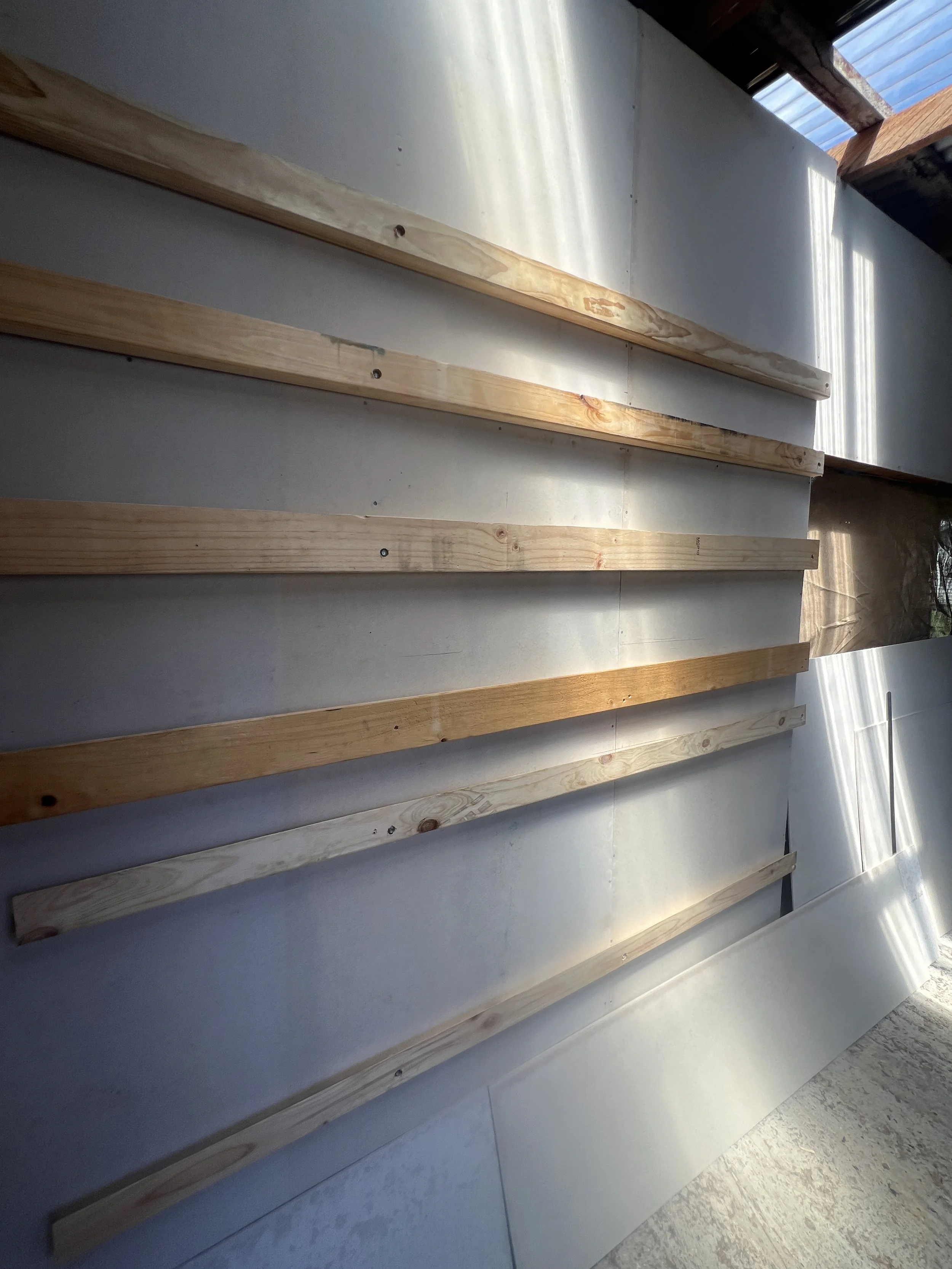
I have long wanted a wall-mounted easel after seeing several artists use them—what a practical idea. Lacking the necessary experience, I hired a skilled professional, and we are now nearly halfway to completion.
Some history of the wall easel
A wall easel is a space-saving painting support that mounts directly to a wall, allowing canvases or paper to be held upright and often adjusted for angle and height; it’s particularly useful in small studios, classrooms, and public display settings where floor easels would be impractical. The concept of fixing a work surface to a vertical plane dates back centuries in various forms—artists have long used strapped or hung boards and frames—but the modern adjustable wall easel as a distinct manufactured tool emerged in the 19th and early 20th centuries alongside increased production of artist supplies and the growth of art education, when makers began producing standardized brackets, clamps, and hinged supports to secure canvases at specific heights and angles, making the device more reliable, widely available, and adaptable to different working methods.
Beyond its practical footprint advantages, the wall easel influences how an artist engages physically and visually with a work. Mounted supports free floor space and reduce the number of freestanding objects an artist must navigate; in tightly packed studios or shared workshop environments, that reduction can be decisive for safety and workflow. The fixed vertical plane also encourages certain compositional habits. Working on a wall easel tends to emulate the experience of viewing finished works as they will be hung, allowing artists to step back and assess proportion, color relationships, and overall impact more naturally than when a canvas is positioned flat on a table. For muralists, portrait painters, and anyone who needs to observe a piece from a distance, the wall easel creates a near-gallery viewing condition within the workspace.
Design variations reflect different uses and user preferences. Simple models consist of a horizontal ledge and a top clamp affixed to rails so the support can slide to accommodate various canvas heights. More sophisticated versions incorporate adjustable tilt mechanisms, spring-loaded clamps, or articulated arms that let the panel swing away for varnishing or to change working angle mid-session. Some wall easels are crafted from wood to match traditional studio aesthetics; others use metal for durability and precise mechanical control. Portable versions are also available: these can be temporarily mounted with brackets or suction fittings for on-site painting or classroom demonstrations, combining the advantages of a wall-mounted support with the flexibility required by plein air or traveling artists.
The educational context has played a significant role in the wall easel’s development and distribution. Art schools and community classrooms value these easels for their neatness and durability. A row of canvases mounted at uniform heights creates an orderly teaching environment and makes it easier for instructors to circulate, critique, and demonstrate. In addition, wall easels help standardize presentation during juries and exhibitions, where consistent placement and viewing angle can reduce variables when assessing student work. Public institutions such as galleries and museums sometimes use customized wall easel systems as part of their hanging hardware, bridging the gap between temporary display and studio practicality.
Material choice and construction matter for performance. A robust wall easel must be securely anchored to studs or masonry; otherwise, the leverage of a large canvas or the force of leaning against the support can compromise safety. Manufacturers specify weight limits and recommended mounting hardware, and many models include adjustable screw fixtures to account for uneven walls. For mixed-media and heavy impasto work, artists often favor metal frames that resist warping and maintain mechanical integrity over time. Wooden easels, meanwhile, retain appeal for their tactile warmth and ability to be repaired or modified by craftsmen who prefer traditional joinery.
Historical and cultural factors inform current preferences. The rise of smaller urban living spaces in the 20th and 21st centuries increased demand for compact studio solutions, pushing wall easels into mainstream use among hobbyists and professionals alike. In regions where studio space is a premium, inventive variations have appeared: fold-flat designs that recess into cabinetry, sliding panels built into communal walls, and modular systems that combine storage with mounting surfaces. These hybrid pieces reflect a practical design ethos—integrating utility with domestic aesthetics so the workspace can coexist within multi-use living environments.
Practical tips help users get the most from a wall easel. Ensure that mounting screws engage solid framing whenever possible and use anchors suited to the wall type. Balance canvases so the center of gravity remains close to the wall; for large pieces, employ dual mounting points to distribute load. Consider adding bumpers or felt pads where the canvas meets the easel to prevent abrasion and to protect delicate frames. When choosing an easel, match its maximum and minimum height range to your typical working positions: the ability to lower a support for fine detail work or raise it for broad gestural marks can influence technique and comfort across long sessions.
In display and conservation contexts, wall easels can also serve non-working roles. Conservators and framers use fixed easels to stabilize works during treatment, and museums may adopt adjustable wall supports for temporary exhibitions to ensure artworks are presented securely and consistently. Thus the wall easel occupies a versatile position